


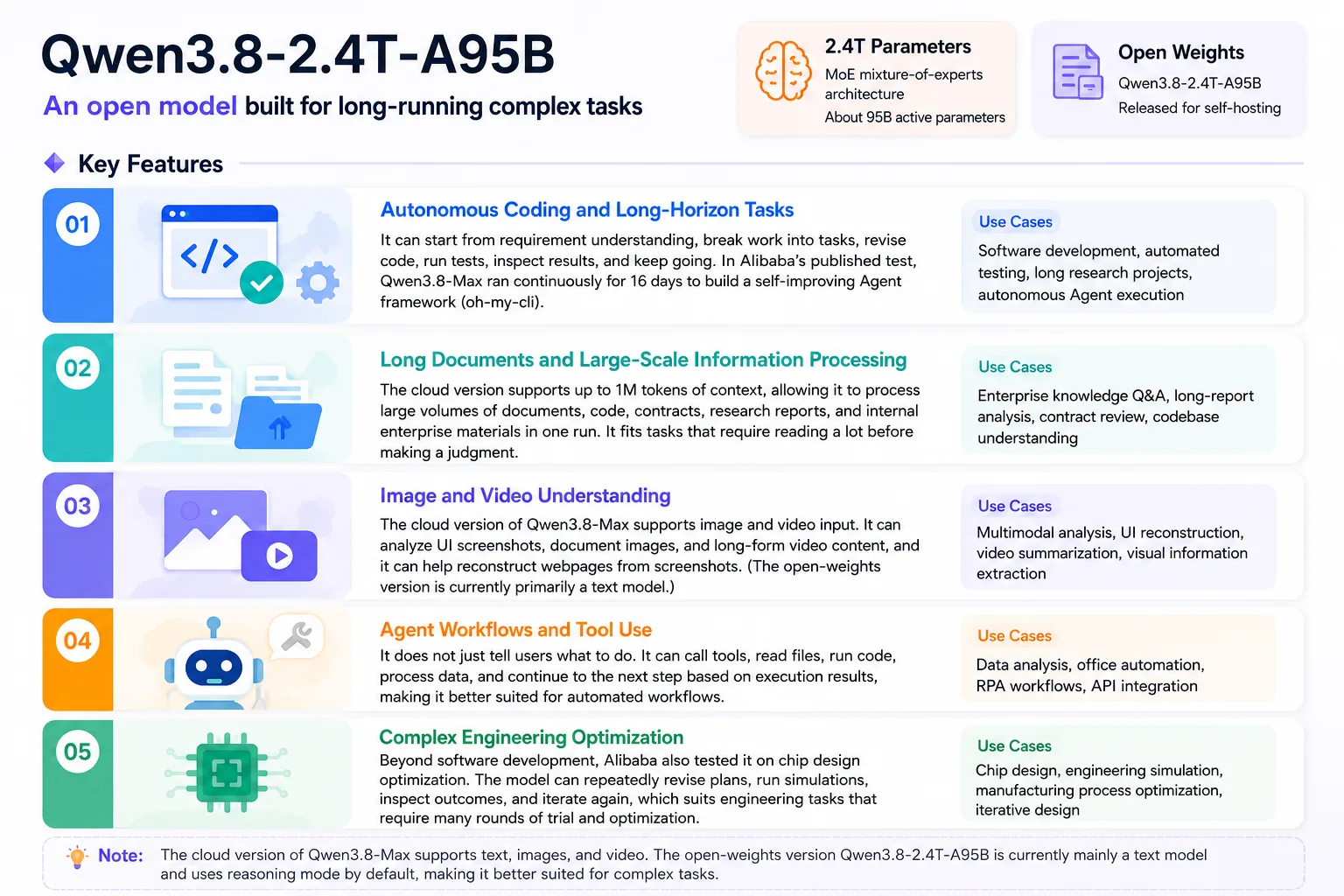
Alibaba previously published a software engineering test that drew a lot of attention.
Qwen3.8-Max ran continuously for 16 days, building a self-improving agent framework from scratch.
During those 16 days, it wasn’t simply generating code nonstop.
It repeatedly went through a full development loop: writing code, running tests, checking the results, finding problems, and then making further changes.
That is actually much harder than producing one good piece of code in a single attempt.
There are now plenty of large language models that can write code, but once a task runs for a long time, models can start to drift.
They may lose track of the original goal, fix one bug only to introduce another, and as the number of files grows, the whole project becomes increasingly difficult to manage.
So the most interesting part of “16 days” isn’t really how impressive the number sounds.
What matters is whether the model can keep making progress over such a long-running task without losing direction.
Of course, this was still a test published by Alibaba itself.
It should not be taken to mean that you can hand any software project to Qwen3.8-Max and leave it completely unattended for 16 days.
Real-world projects still involve development environments, permissions, dependencies, third-party APIs, deployment, and team collaboration.
Beyond coding, Qwen3.8-Max has also been strengthened in long-context processing, multimodal capabilities, and tool use.
The cloud version supports up to 1 million tokens of context, allowing it to process a very large amount of information at once.
The open-weight Qwen3.8-2.4T-A95B supports around 260,000 tokens natively and can be extended to roughly 1 million tokens.
However, the two versions should not be treated as the same thing.
The cloud version of Qwen3.8-Max can work with text, images, and video, while the open-weight Qwen3.8-2.4T-A95B is currently mainly a text-only model.
The open-weight version also has another notable characteristic: reasoning mode is enabled by default.
That makes it better suited to complex tasks, but it can feel a bit heavy for very simple question-and-answer use cases.






Comments (0)