
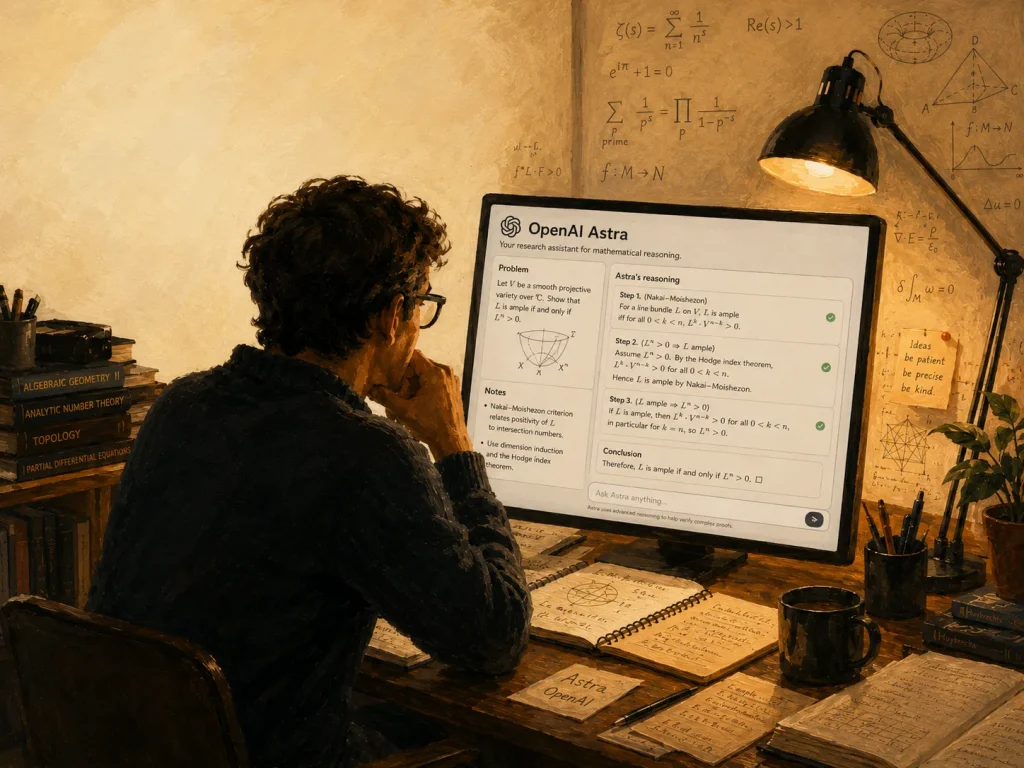
Late at night, a researcher sits in front of a screen covered with formulas. The problem has no known answer and no simple path forward. Then the model suggests a line of reasoning worth testing.
OpenAI has revealed that it is developing a new model called Astra. The system is still being tested internally, and no release date has been announced.
What has drawn attention is not its speed or its ability to answer routine questions. Astra is being used on real research problems in mathematics and theoretical computer science.
The latest work covers ten difficult problems in areas including geometry, coding theory, group theory and quantum computing. Some have reportedly been solved, while others have seen meaningful progress. That does not mean ten famous “century-old mysteries” have suddenly disappeared. The reality is more measured, and more interesting.
Research mathematics is very different from solving an exam question. There is no answer sheet, and a promising proof can fall apart because of one small mistake. Progress often comes from trying many ideas, rejecting most of them and following the few that survive careful checking.
Astra’s role is closer to that of a tireless research assistant. It can test approaches, work through long chains of reasoning and point researchers toward ideas they may want to explore further.
Its output is not treated as fact. Human mathematicians still have to review the argument, rewrite the proof and check every step. Formal verification tools such as Lean can help, but new results also need scrutiny from other experts.
OpenAI has already shown how this kind of collaboration might work. In an earlier project on the unit distance problem, an internal model found a route that challenged a long-standing assumption. Mathematicians then examined the proof.
The larger story is not about machines replacing mathematicians. It is about changing how research gets done.
Humans still decide which questions matter, whether an argument makes sense and what a result means. A system like Astra can handle long stretches of calculation, trial and error, and technical exploration.
For generations, mathematicians have worked through difficult problems with notebooks, chalkboards and long hours of silence. In the future, they may have another presence in the room: not an oracle, and not always right, but sometimes capable of offering the one idea that keeps the work moving.