GLM 5.2

3.25
Z.ai's large-scale reasoning model with 1M context, excels at coding and complex automation, supports high-intensity reasoning, and handles full development workflows in a single task.
Advertisement 728 × 90
CompanyZ Ai
Context1M
Released2026-06
Updated2026-07-20

GLM 5.2 Overview

GLM 5.2 is a large-scale reasoning model from Z.ai. It supports text input and output with a 1M-token context window, and is suited for long-horizon agent workflows, project-level software engineering, and complex multi-step automation.

Reasoning efforts high and xhigh are supported; xhigh maps to max reasoning. It is particularly strong at coding and tool use across long-running tasks, able to maintain engineering context and follow standards consistently through a full development workflow, from requirements to multi-platform deployment, in a single task.

GLM 5.2 Pricing

PlanPriceDescription
Z.ai API Access Input $1.40 / Output $4.40 per 1M Tokens Supports a 1M-token context window and up to 128K maximum output tokens. Cached input is priced at approximately $0.26 per 1M Tokens. Model weights are released under the MIT license.
OpenRouter API Access Input $1.00 / Output $4.00 per 1M Tokens Access GLM Coding models through the OpenRouter platform with flexible API integration options. Pricing may vary based on platform fees and updates.
GLM Coding Subscription Plans Approx. $10–$112/month Developer-focused coding plans with different usage limits. Lite starts at around $10/month, Pro around $30–50/month, and Max around $80–112/month.
Self-Hosted Deployment (Open Weights) Free (hardware required) Download and run the open-weight model on your own GPU infrastructure. No API usage fees, making it suitable for developers and enterprises requiring private deployment.

GLM 5.2 Key Features

Large-Scale Text Reasoning — Supports text input and output with powerful logical reasoning capabilities.

Million-Token Context Window — 1M token capacity, capable of processing ultra-long documents, complete codebases, or multi-turn conversation histories in a single pass.

Multi-Level Reasoning Intensity Adjustment — Supports two modes, high and xhigh, with xhigh corresponding to maximum reasoning depth, allowing on-demand balancing of speed and effectiveness.

Agent Workflow Support — Suitable for long-running agent tasks, enabling autonomous planning, tool calling, and multi-step execution.

Project-Level Software Engineering — Maintains consistent context and standards compliance throughout the entire workflow, from requirements analysis and coding implementation to multi-platform deployment.

Complex Multi-Step Automation — Excels at handling compound tasks that require continuous decision-making and tool invocation.

Summary

Software Development Engineers — Developers handling large codebases, cross-file refactoring, full-stack development, or building projects from scratch. They leverage the 1M-token context and deep reasoning to complete the entire workflow from requirements to deployment in a single task.

AI Agent Developers — Those building long-running agent applications (e.g., automated operations, smart customer support, research assistants) that require autonomous planning, tool calling, and multi-step execution.

Data Scientists & Analysts — Professionals dealing with ultra-long documents (research papers, legal contracts, financial reports), complex data analysis, or cross-document information integration.

Tech Leads / Architects — Technical managers responsible for evaluating large-scale engineering solutions, technology selection, code standard reviews, and maintaining overall project consistency.

Automation Workflow Designers — Those in charge of enterprise-level multi-step automation tasks (CI/CD pipelines, documentation generation, testing-deployment coordination) requiring stable execution of complex workflows.

Researchers & Academics — Researchers who need to read, summarize, compare large volumes of literature, or conduct multi-step logical derivations and experimental design.

Advanced Users Demanding High Reasoning Quality — Users not satisfied with shallow responses from ordinary models, seeking deep thinking, rigorous reasoning, and high-quality output.


Comments (0)

Leave a comment

Advertisement 728 × 90

Z Ai Model Comparison

Model Context Pricing API Released Global Heat
GLM 5.2
1M Paid YES 2026-06
65/100
1.3M YES 2026-08
1M YES 2026-08
68/100

Similar Models

GLM 5.3
68
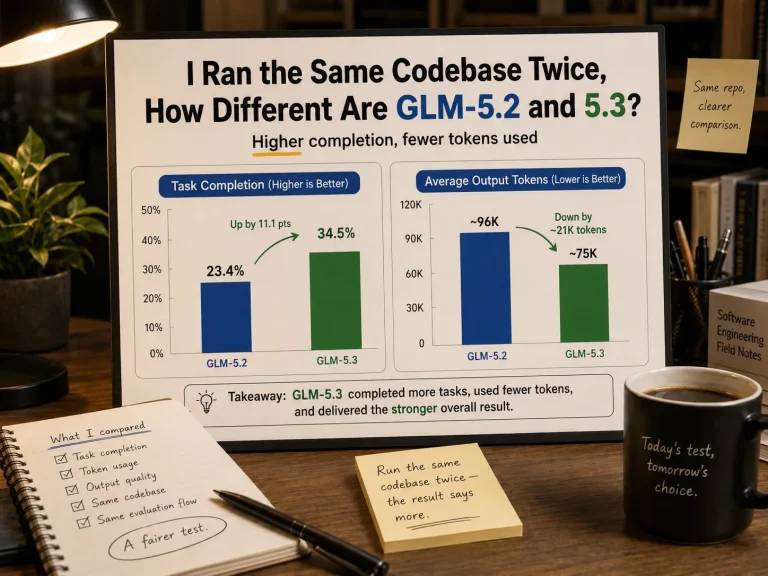
Just two months after GLM-5.2 landed in June, Zhipu AI released GLM-5.3 on August 14. The interesting part is what didn’t change. GLM-5.3 keeps the same base model and the same MoE architecture with about 743 billion parameters. Most of the gains come from scaling up post-training instead.
Z Ai
GLM 5.3 Flash
Ox Alpha topped OpenRouter on day one and broke the token record.Zhipu confirmed it as GLM-5.3-Flash on Aug 26.
Z Ai
Claude Opus 5
100
Anthropic’s flagship Claude model built for complex reasoning, AI Agents, software development, and enterprise knowledge workflows.
Anthropic
GPT-5.5 Pro
99
I’ve been using GPT-5.5 Pro with a few colleagues for the past several weeks, mostly on the kinds of jobs where regular chatbots tend to fall apart: long documents, messy research questions, code debugging, and tasks that need more than one or two steps of reasoning.
OpenAI
GPT-5.5
99
OpenAI flagship model, a multimodal AI natively supporting text, images, and audio.
OpenAI
GPT-5.6 Luna
99
An efficient GPT-5.6 series model optimized for speed, cost efficiency, and intelligent performance across large-scale AI applications.
OpenAI
Claude Opus 4.8
98
Claude Opus 4.8 is Anthropic's most powerful Opus-series model, featuring multimodal input, reasoning, and a 1M-token context window, excelling in complex reasoning and coding.
Anthropic
GPT-5.6 Luna Pro
97
OpenAI’s next-generation efficient AI model, balancing speed, cost, and intelligence for chat, coding, and automation tasks.
OpenAI

Related News