GLM-5.3

3.40
Just two months after GLM-5.2 landed in June, Zhipu AI released GLM-5.3 on August 14. The interesting part is what didn’t change. GLM-5.3 keeps the same base model and the same MoE architecture with about 743 billion parameters. Most of the gains come from scaling up post-training instead.
Advertisement 728 × 90
CompanyZ Ai
Context1M
Released2026-08
Updated2026-08-18

GLM-5.3 Overview

GLM-5.3 is the latest large language model from Zhipu AI, which operates internationally under the Z.ai brand.
It shares its base with GLM-5.2 and focuses heavily on post-training scaling: large-scale reinforcement learning across harder, longer, and more varied task environments.
Its main use cases are fairly focused: coding, complex software engineering, and tasks that require sustained execution over long horizons.
GLM-5.3 is text-only and supports a context window of up to 1 million tokens. That gives it enough room to ingest large codebases and work across multiple files without constantly dropping earlier context.

GLM-5.3 Pricing

PlanPriceDescription
Lite $12.60 / $18 per month 10,000 credits per week; aimed at lighter coding workloads and smaller projects
Pro $56 / $80 per month Around 6× the Lite allowance; better suited to daily development work
Max $117.60 / $168 per month Around 14× the Lite allowance; designed for heavy usage and larger projects

Usage outside the weekday peak window of 2:00–6:00 PM (UTC+8) costs half as many credits.

When accessed through ZCode, context-cache hit rates can exceed 98%, which can reduce the effective cost of long coding sessions.

GLM-5.3 Key Features

1. A Big Jump in Coding Performance

Coding is the clearest area of improvement.

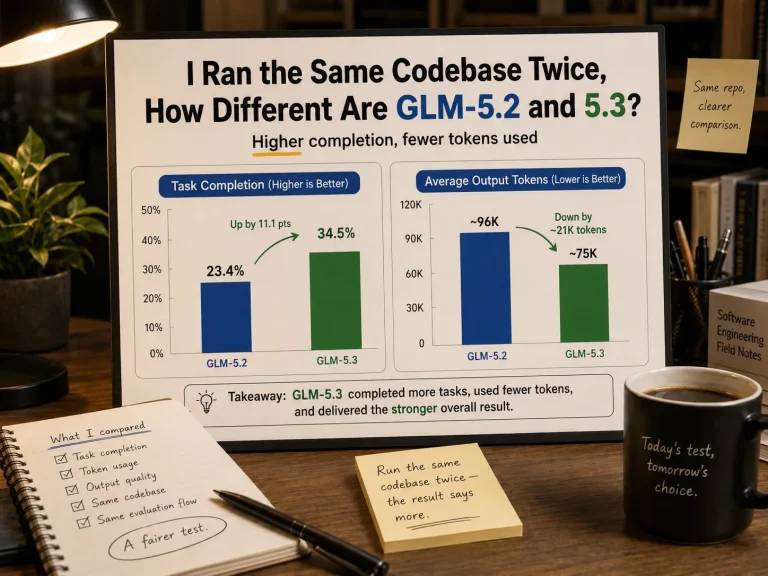
In Zhipu AI’s internal coding evaluations, GLM-5.3 scores about 50% higher than GLM-5.2.

The gap is particularly large on Terminal-Bench 3.0, where the score rises from 4.6 to 28.3, ahead of Kimi K3 at 17.4.

On DeepSWE, a benchmark focused on longer software-engineering tasks, the score moves from 46.2 to 66.9, putting it close to Claude Fable 5 at 69.7.

These aren’t just short code-completion tests. They involve working in terminals, understanding projects, editing across files, and keeping a task moving over multiple steps. That is where most of the improvement shows up.

2. Lower Token Usage

For coding agents, accuracy is only half the story. Token consumption can quickly become the more expensive part of a long task.

At the High reasoning setting, GLM-5.3 uses about 50,000 tokens per task on average while reaching 31.4% accuracy. Claude Opus 4.8 uses roughly 120,000 tokens for 29.5% accuracy in the same comparison.

That difference matters once an agent starts looping through files, running tools, revising code, and carrying context across many turns.

For heavy users, lower token usage translates directly into lower operating cost.

3. Stronger Cybersecurity Performance

Security is another area where the model posts substantial gains.

On the CyberGym vulnerability-reasoning benchmark, GLM-5.3 scores 84.5%, compared with 83.8% for Anthropic Mythos 5.

In a separate security effort, the model was used across 269 projects and helped identify 2,436 real vulnerabilities, including a high-severity DNS protocol issue that had remained undetected for more than 40 years.

That capability also raised the bar for releasing the weights safely. Zhipu AI delayed the open-weight release by two weeks to add further safeguards.

4. What Changed From GLM-5.2

The main change is in training, not model size.

Zhipu AI put more reinforcement-learning effort into terminal use, complex codebases, and long-horizon engineering tasks. Instead of training primarily around isolated prompts, the model spends more time working through environments that look closer to actual development work.

The gains are concentrated in the same areas: sustained execution, cross-file reasoning, and more involved engineering tasks.

GLM-5.3 is less a new foundation model and more a proof of how much post-training can still pull out of an existing one.


Summary

Strengths

Strong coding performance, especially on long-running engineering tasks; relatively efficient token usage; and solid results on vulnerability analysis and security reasoning.

Limitations

GLM-5.3 is text-only, so it cannot directly handle images or video. Reasoning cannot be fully disabled, only reduced, which may waste tokens on very simple tasks. API access is also fairly limited, with Coding Plan serving as the main access route.

Recommended for

Developers using AI for serious coding work, large codebases, refactoring, coding agents, and security research.

Not recommended for

People mainly looking for casual chat or basic Q&A, or anyone whose workflow depends heavily on image and video understanding.

Comments (0)

Leave a comment

Advertisement 728 × 90

Z Ai Model Comparison

Model Context Pricing API Released Global Heat
GLM-5.3
1M YES 2026-08
68/100
1M Paid YES 2026-06
65/100

Similar Models

Related News