
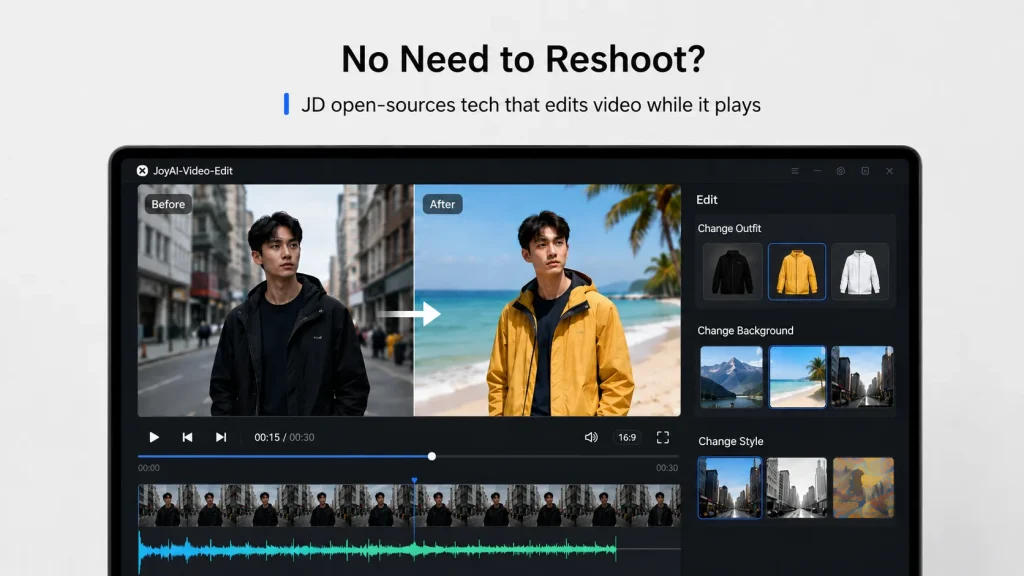
Imagine watching a video and being able to change the person’s clothes, replace the background, or turn the whole scene into a different visual style — without recording it again.
This is becoming possible with a new open-source video editing technology released by JD.com.
On August 5, JD officially open-sourced JoyAI-Video-Edit, a video editing model that allows users to modify videos while they are playing. The company has released the model, related code, technical documents, and an online demo for developers and researchers.
Unlike traditional video editing tools that usually require users to upload an entire video and wait for processing, JoyAI-Video-Edit works in a more continuous way. It can process video frames as they come in and apply changes based on simple text instructions.
For example, users can ask the system to “change the jacket color,” “remove an object from the scene,” “replace the background with a beach,” or “turn the video into a watercolor style.” The system then applies those changes to the video content.
For video creators, livestreamers, and everyday users, this could make editing much faster. Instead of spending hours adjusting clips after filming, people may be able to try out new ideas while creating content.
In the past, making these kinds of changes often required professional editing software and a lot of manual work. Even a small adjustment could mean repeating multiple steps. Real-time video editing technology aims to make the process more natural, closer to simply telling a computer what you want.
According to JD’s public information, JoyAI-Video-Edit supports several editing tasks, including changing objects, replacing backgrounds, removing elements from videos, and adjusting visual styles. Technical tests show that the model can achieve near real-time processing speeds on high-performance computing hardware.
The technology is still mainly designed for developers and researchers. Running this type of model requires powerful computing resources, so it is not yet something most people can use directly on a regular laptop. Future improvements in hardware and software optimization will determine how quickly these features reach everyday video apps.
For many people, video creation has always involved learning complicated editing tools. In the future, creating a video may become much simpler: users describe the change they want, and the software helps bring that idea to life.
The release of JoyAI-Video-Edit shows how video production is changing. Videos may no longer be just recordings of moments — they could become flexible digital spaces where people can create, adjust, and explore new possibilities more freely.