I used Gamma to create three things:
a weekly team meeting deck, a product proposal, and a presentation for an international audience.
Almost no learning curve the first time
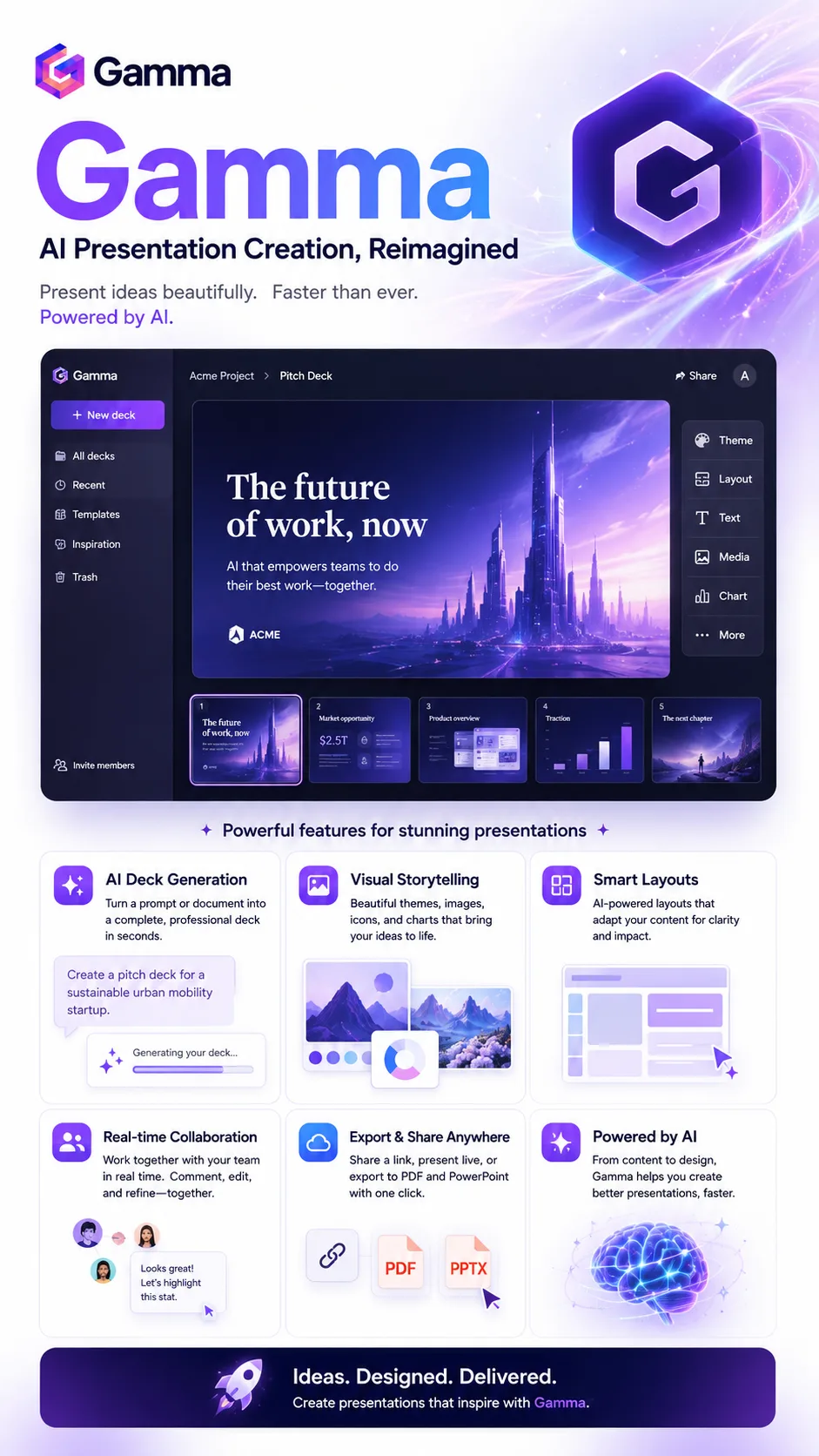
After signing up, I clicked Create and chose the AI generation option.
My first prompt was:
“2026 Q3 product roadmap.”
I picked the number of pages, chose a style, and waited.
A few dozen seconds later, the cover, agenda, content pages, and visuals were already there.
That feels slightly counterintuitive the first time.
With traditional PowerPoint, I’ve always assumed the first step is opening a blank file and figuring out the layout.
Gamma basically removes that step.
Instead of staring at a blank page, you start with something that’s already usable and editable.
That gets addictive pretty quickly.
The visual quality was better than I expected
My biggest concern was that it would look too template-driven.
AI-generated presentations often have this feeling:
“Everything is neatly arranged, but you can immediately tell a machine put it together.”
Gamma wasn’t nearly as obvious.
At least in the decks I made, the typography, spacing, colors, and balance between text and visuals all felt fairly natural.
It also doesn’t always just drop in a random stock image.
Sometimes it generates a visual based directly on the topic of the slide.
I sent one of the decks to a designer on my team.
His reaction was:
“The layout is more consistent than what you get from a lot of interns.”
I think that’s pretty accurate.
Gamma probably won’t replace a professional designer, but for most non-design roles, the first draft is already at a surprisingly high level.
Gamma Agent is the feature I kept going back to
Once the first draft was generated, I didn’t spend much time manually adjusting styles.
More often, I just told Agent:
“This slide is too crowded. Split it into two.”
“Make the whole deck feel more restrained and corporate.”
“This image looks too AI-generated. Replace it.”
That workflow feels very natural.
Before, I would think about how to move a specific component.
Now it feels more like telling a design assistant what I want the end result to look like.
It doesn’t understand perfectly every time.
But for most ordinary changes, it really is faster than adjusting everything manually.
Chinese copy still needs a human check
Chinese was one of the more noticeable weak points for me.
It’s not that Gamma can’t write Chinese.
The issue is that some sentences can sound a little too “AI.”
With professional content in particular, it sometimes takes an accurate term and rewrites it into something more conversational.
For example, a precise term like “conversion rate optimization” might get simplified into something closer to “improving conversion performance.”
The meaning is similar, but in professional materials, that difference matters.
So when I use Gamma for Chinese presentations now, I don’t treat the generated copy as final.
I’m happy to let it handle the layout.
But I still review the important wording myself.
PPTX export is another thing to watch
Gamma feels best when you present directly from the web version.
That’s where the layout, fonts, and animations are most likely to look as intended.
Once you export to PPTX, things can change.
I’ve seen fonts shift, and I’ve also had a few layouts move slightly.
If I’m presenting it myself, I’d rather just use Gamma directly.
If a client specifically asks for a PowerPoint file, I always export it and open it again for a final check.
That matters.
Just because something looks perfect inside Gamma doesn’t mean the PPTX will look exactly the same.
The experience in China can be less stable
This is another practical issue that’s hard to ignore.
The servers are overseas, so loading can sometimes be slow from mainland China.
Editing alone is usually manageable.
With several people collaborating at the same time, the latency becomes more noticeable.
If you mainly create content for international audiences, I don’t think it’s a major problem.
But if your entire team is based in China, I’d definitely test the real experience before rolling it out.
Pros
The first draft is genuinely fast.
You can see a complete presentation within seconds, which is dramatically faster than starting from a blank page.
The design quality is high enough for most users.
Colors, spacing, and visual balance are usually solid enough to keep working from immediately.
Gamma Agent is genuinely useful.
Editing a whole deck through natural language is often much easier than adjusting layouts piece by piece.
Very low learning curve.
You don’t need to learn design software first. If you can describe what you want, you can start.
Flexible output formats.
The same content can become a presentation, webpage, or document.
The paid entry point is reasonably priced.
Plus works out to around $9/month on annual billing, which isn’t expensive if you make presentations regularly.
Cons
Chinese copy still needs human review.
Professional terminology and formal phrasing can sometimes get oversimplified.
PPTX export isn’t completely reliable.
Fonts and layouts may differ from the web version.
The network experience in China is only average.
Loading and real-time collaboration can feel slower.
The visual style leans international.
It looks great for creative proposals, but may not always fit traditional corporate presentations in China.
You do need to keep an eye on Credits.
It’s not a big issue for normal use, but Agent, API, and advanced image generation can make the balance matter.
Who it’s good for
Office workers who regularly need presentations fast
Weekly meetings, monthly reports, proposals, and project introductions are all good use cases for letting Gamma create a first draft.
The real time savings aren’t in “creating the content.” They’re in formatting it.
Startup teams and founders raising money
Pitch decks change constantly.
If you’re repeatedly changing numbers, structure, and visual style, Gamma can be much faster than traditional PowerPoint.
Educators and trainers
Drop in a course outline, and you can quickly turn it into a deck that’s ready to refine.
People creating content for international audiences
Gamma’s overall visual language feels fairly international, and multilingual content is convenient to work with.
Teams that need lots of content variations
With API and automation, you can generate different versions for different customers, countries, or use cases at scale.
Who it’s not ideal for
People who need extremely precise Chinese wording
For legal, medical, or technical documentation, AI-generated copy should not be used without review.
Teams that need perfectly reliable PPTX delivery
If your workflow requires PowerPoint files to open with absolutely no layout differences, Gamma can add an extra QA step.
Formal business presentations in China
Especially in state-owned companies, government organizations, or very traditional industries, Gamma’s default visual style may feel too casual.
People who only make one or two presentations a year
Free is enough for occasional emergencies. If you barely use presentations, there isn’t much reason to maintain a subscription.











Comments (0)